
The Complete Guide to School Dining Tables
Apr 16, 2026 • 11 minutes
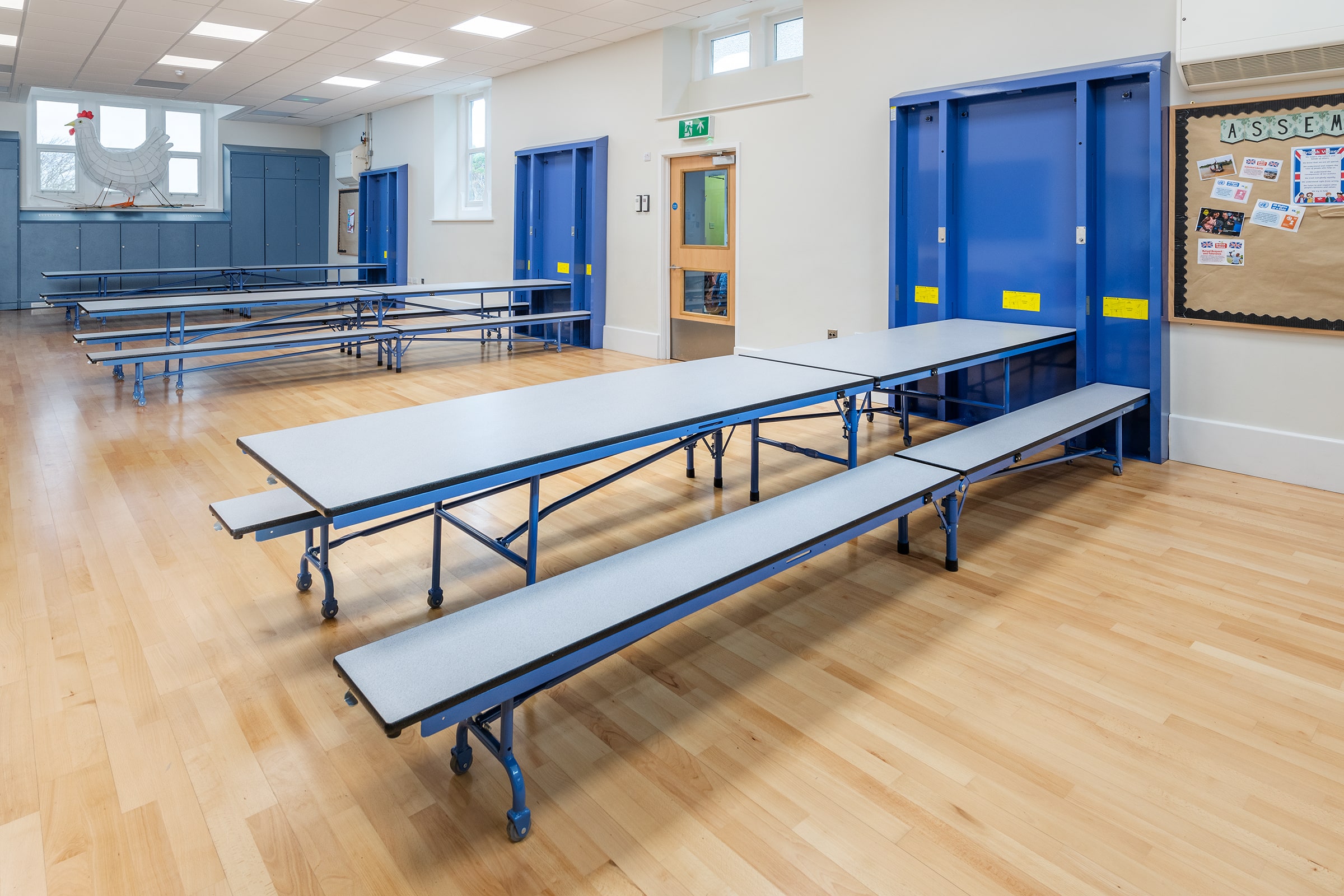
Few pieces of school furniture take as much daily punishment as the dining table. Hundreds of students sit down, eat, spill, stack and move on in the space of an hour, and that cycle repeats across multiple sittings, five days a week, for years. The tables need to hold up under that kind of use. They also need to fold away quickly when the hall is needed for other activities, and they need to create a space where students want to sit and eat rather than rush through lunch and leave.
Westcountry Group’s Versa range of mobile folding tables was designed around exactly these demands. We have spent over 45 years working with schools across the UK and in that time, we have learned what works in a busy dining hall and what does not. This guide draws on that experience to help you choose the right dining furniture for your school, covering the practical considerations first and then looking at each product in our range.
How to Choose the Right Dining Tables for Your School
Before looking at specific products, consider these four factors that will shape which tables work best in your school.
Space and Layout
Start by measuring your hall, and not just the total floor area. Map out where your serving stations sit, where students queue, where the fire exits need clear routes and how much usable dining space you have once you account for all of that. A long, narrow hall presents very different challenges from a wide open space, and both differ again from a hall with pillars, alcoves or an awkward stage area eating into the usable floor. Even the position of doors matters, because a main entrance at one end of the hall creates a natural traffic flow that your table layout either works with or fights against.
Most school halls do not serve dining alone. If yours also needs to host assemblies, PE lessons or exams, you need furniture that your staff can set up and clear without it becoming a logistical exercise that eats into the timetable. Think about how many lunch sittings you run, how tight the turnaround time is between them, whether the hall needs to be completely empty for other activities and how many members of staff are realistically available to move furniture at the changeover.
Student Numbers and Age Groups
A reception child and a Year 11 student have very different needs when it comes to table height, seating type and personal space. Younger children between the ages of four and 11 tend to do well with lower tables and bench seating that keeps smaller students contained and makes supervision easier for staff who are managing an entire year group at once. Secondary students between 11 and 16 need standard heights and noticeably more room between seats. Crowding older students into tight configurations creates tension and behavioural issues that ripple into the afternoon. Sixth formers and college students respond better again to individual seating that gives them a degree of independence and personal space during their break.
Budget and Long-Term Value
A cheaper school dining table that needs replacing after five years will cost you more over its lifetime than a well-engineered product that folds easily, stores compactly and comes with a proper warranty. Storage is another hidden cost that catches schools out. If the furniture needs a dedicated storeroom when not in use, that is floor space your school cannot use for anything else and in a building where every room is under pressure, giving up a space that could be a small group room or a store cupboard is a real trade-off.
Think about staffing costs too. If your current tables take 20 minutes and two members of staff to set up for each sitting, that is over three hours of staff time every week just on furniture. Tables that a single person can deploy in five minutes change that equation significantly over the course of a year. We go into the planning side of this in more detail in our guide to designing a multi-use school hall.
Safety and Compliance
Folding mechanisms, heavy tabletops and hundreds of children in one space make safety non-negotiable. You should look for anti-pinch mechanisms on all folding joints, because fingers caught in a folding table is one of the most common dining hall injuries. Rounded or protected edges across every surface reduce impact injuries, stable bases prevent tipping when students inevitably lean or push against them and positive locking in both the open and stored positions means a table stays where it should whether it is in use or folded against a wall.
Your furniture should comply with BS EN1729 (Part 1) for age-appropriate dimensions and your maintenance arrangements need to satisfy PUWER (Provision and Use of Work Equipment Regulations). Our maintenance plan guide covers the benefits of keeping your tables compliant and safe over the long term in more detail.
Our Versa Range of School Dining Tables
Every table in our Versa range shares a common platform of ultra-durable, hygienic surfaces, tamper-proof moisture-resistant polyurea edging, over 160 laminate colour options, custom logo and image printing, wheelchair-accessible configurations and a 15-year manufacturer’s warranty as standard.
We also offer a free lifetime warranty on selected products when you agree a service and maintenance contract at the point of purchase. Where the four table types differ is in how they store, how many students they seat and which hall layouts they suit best.
Wall Pocket
Our Wall Pocket system mounts to the wall and folds down when you need it for dining, then folds flat against or within the wall when the hall needs clearing. Tables and benches store together as a single unit, which means there is no stacking, no trolleys and no dedicated storeroom required. Your staff can set up a full dining layout in minutes and clear it just as quickly when the hall needs to switch to another use. For schools where the hall needs to be an empty, open space between sittings, nothing in our range clears a floor faster.
You can choose between two installation methods depending on the features of your school canteen:
- Surface mounting works on any solid wall and suits most existing school buildings where you want to add Wall Pocket to a hall that was not originally designed for it.
- Recessed installation sits the unit within a wall cavity so it finishes completely flush when folded, leaving a clean, uninterrupted wall surface that gives no indication there are dining tables behind it. Architects and planners designing new-build schools often specify the recessed option at the design stage because the cavity can be built into the wall from the outset.
We also offer optional 360-degree multi-directional castors that let you reposition units rather than fixing them permanently to a single wall location, which is useful in halls where the layout needs to change depending on the event. Each set operates independently, so you can fold some away and keep others open to match the number of students in any given sitting.
Benchmark
The Benchmark is a freestanding mobile table with integrated folding benches that nests compactly when stored. Six tables fit into a footprint of less than 1.6 metres by 2.24 metres and each additional table adds only 28 centimetres of depth to the stack. To put that into perspective, you can store enough tables to seat over 100 students in a space not much bigger than a large cupboard, which is a significant consideration for schools where storage space is already under pressure.
A lift assist system makes the folding mechanism smooth to operate, so your staff are not wrestling with heavy tabletops at the end of a long lunch service. DoubleGuard anti-tipping feet keep the tables stable in both the down and upright positions and anti-glide legs prevent a gradual creep across the floor. Extended tabletops let you position tables end to end for larger group arrangements when you need a longer run of seating for events or themed dining days.
Hallmark
Where the Benchmark uses integrated benches, our Hallmark uses individual stools secured by heavy-gauge steel plates at four points per stool. A dual-spring mechanism makes setup and packaway straightforward for your staff and easy-glide wheels let them move the tables into position without dragging them across the floor and scuffing the surface.
The stool design gives the Hallmark a particular advantage when it comes to accessibility. You can remove individual stools, so wheelchair users pull up directly to the table alongside their peers, eating together rather than being placed at a separate accessible table. Wheelchair-accessible configurations seat eight, 10 or 12 students and because you are removing stools rather than reconfiguring the whole table, you can adjust the number of accessible spaces sitting by sitting depending on who is dining.
ConverTables
Our ConverTables are unique from everything else in the range because a single unit transforms between three configurations: a full-sized dining table, bench seating with a backrest for assemblies or lectures and a single-sided lecture desk for exams or classroom work. One set of ConverTables does the job of three separate sets of furniture, which means fewer items to purchase, less to store and faster transitions between activities.
A hidden safety latch sits under the tabletop, keeping the mechanism out of sight and out of reach of students. The 2.4-metre version makes contact with the floor at eight points including four seat-support legs, giving the stability you need when a hall full of students is leaning on, reaching across and generally putting the furniture through its paces every lunchtime.
How Many Students Does Each Table Seat?
Here is how capacity breaks down across our Versa range:
- Wall Pocket seats up to 22 primary-age children per single set, scaling to 44 (double), 66 (triple) and 88 (quad) along a wall. Each set operates independently, so you can adjust capacity sitting by sitting without moving a single table.
- Benchmark seats 12, 14 or 16 to 20 children per table depending on the length you choose. The largest configuration delivers the highest per-table capacity in the range, making it the strongest choice when you need to push through high numbers per sitting.
- Hallmark seats eight, 12 or 16 children in standard configurations and eight, 10 or 12 in wheelchair-accessible arrangements. The variety of table shapes helps you fill irregular floor spaces more efficiently than a single rectangular layout would. If your hall has an L-shape, a wide bay window area or columns that break up the sightlines, mixing Hallmark shapes lets you seat students in areas that rectangular tables would leave empty.
- ConverTables vary by mode. Dining mode delivers the most seats per unit, while exam mode spaces students at individual desks. Capacity drops in exam mode, but you gain the ability to run exams without owning or storing a single separate exam desk.
Rectangular or Round: Which Layout Works Best?
Table shape affects both how many students you can seat and the social atmosphere of your dining hall. Rectangular tables pack the most seats into the available space. They line up neatly in rows, make the best use of narrow or corridor-style halls and give you the tidiest overall layout. For schools where the priority is getting the maximum number of students through lunch as efficiently as possible, rectangular configurations are the obvious choice.
Round tables create a different dynamic. Every student faces the centre, which encourages conversation and removes the hierarchy that long rows can sometimes create. They work well in wider halls and for smaller group settings where a calmer, more social atmosphere is the aim. Some schools find round tables particularly effective for SEN students or younger children who benefit from a more inclusive dining environment where the layout itself feels less overwhelming.
Most schools we work with end up using a combination of both. Rectangular tables handle the volume in the main area, while round tables placed in a separate zone provide a quieter setting for smaller groups and students who need a calmer space during the lunch break. The balance between the two depends on your hall and your students, and it is something we can help you work out when we visit for a site survey.
Durability and Materials
Every table in our Versa range uses ultra-durable, hygienic surfaces that resist scratching, staining and heat damage. Tamper-proof, moisture-resistant polyurea edging absorbs impact and prevents the chipping that plagues cheaper alternatives, which is particularly important on folding tables where the edges take repeated contact every time the table is opened and closed. Steel frames with powder-coated finishes resist corrosion even in the high-moisture environment of a busy dining hall where spills, steam from a serving area and daily cleaning all contribute to a tougher-than-usual operating environment. Non-porous surfaces make cleaning between sittings quick and straightforward, meeting the hygiene standards you need in a school setting.
We back every product in the range with a minimum 15-year manufacturer’s warranty. Wall Pocket and Benchmark tables qualify for a free lifetime warranty when you agree to an annual service and maintenance contract at the point of purchase. Those contracts include safety compliance checks and HSE/PUWER inspections, so you are not just protecting the furniture itself but keeping on top of the regulatory requirements that apply to any equipment your staff use in the course of their work.
Talk to Us About Your Dining Hall
Whether you would like to upgrade your current dining furniture or are looking for something new, we have delivered a number of multipurpose and dining hall projects that meet the needs of education environments. Here is what our customers had to say about our work.
Contact us today to find out more – call 0330 030 0330, email: [email protected] or visit the Versa section of our website.