
How Does The Wall Pocket System Work?
Dec 9, 2025 • 5 minutes
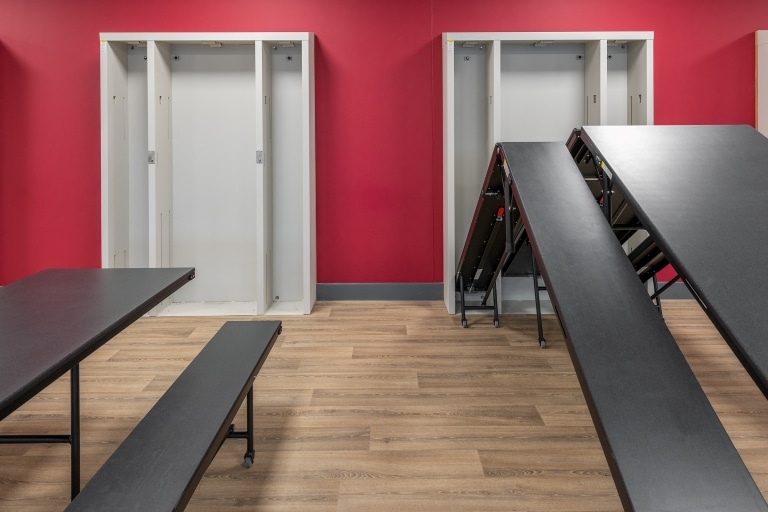
School halls are busy places. They host assemblies, PE lessons, drama rehearsals, exams and, of course, lunches. For many schools, the challenge is making one space do the job of several, often with limited time between activities to reconfigure the room.
The Wall Pocket from Westcountry Group’s Versa range of mobile folding tables is designed with exactly this problem in mind. It is a wall-mounted dining furniture system where tables and benches fold away into a recessed or surface-mounted cabinet when not in use, freeing up floor space for other activities within minutes. The tables and benches operate independently of each other, so staff can set up exactly the configuration they need for each sitting.
If your school is considering Wall Pocket furniture, or you have recently had it installed, understanding how it works will help staff use it safely and efficiently.
How the Wall Pocket Stores Away
When not in use, the tables and benches fold up and slide into a wall-mounted cabinet. The cabinet can be recessed into the wall for a flush finish or surface-mounted onto an existing wall.
A single set sits just 16 centimetres out from the wall when folded, and even a quad configuration takes up only 58 centimetres. If your school is being designed or undergoing a major refurbishment, the recess can be specified at the design stage and built into the wall structure from the outset. We provide 2D and 3D CAD blocks on request to help architects and planners integrate Wall Pocket into their designs early in the process.
Once stored, the cabinet is locked. This prevents anyone from accidentally unfolding the furniture when it is not needed and keeps the dining area clear for other uses. With the furniture tucked away, the hall is ready for PE, assemblies or any other activity within minutes of the last lunch sitting.
Seating Capacity
A single Wall Pocket set seats up to 22 primary-age children and because each set operates independently, you can scale up by adding more units along the same wall. A double set accommodates up to 44 students, a triple up to 66 and a quad configuration seats up to 88. You do not have to open every set at every sitting either. If a smaller year group is eating, you can leave some units folded and only open what you need.
Setting Up the Wall Pocket
Setting up the Wall Pocket is straightforward and can be done by one or two members of staff in a matter of minutes.
Each unit comes with a handle that hooks onto the edge of the table or bench, allowing staff to pull the furniture out of the cabinet without bending down to floor level. This is an important detail for staff who set up and clear away dining furniture multiple times a day, as it reduces strain on the back.
Once hooked, the table or bench slides out on a wheeled base. As it moves, the furniture unfolds in a concertina motion until it lies flat, parallel with the floor. A central latch then locks the piece securely in place, ready for use.
If you notice a slight rise in the centre of the table or bench once it is fully extended, this is normal. It is caused by the high quality springs used in the mechanism and does not affect the stability or safety of the furniture.
Clearing Away After Lunch
When it is time to clear your school dining area, it could not be easier to pack away your Wall Pocket furniture.
Start by releasing the central latch. This is done by pulling a rounded black handle, which has been positioned to keep fingers clear of the mechanism. Once released, lift the centre of the table or bench and push the far edge along the floor until it meets the cabinet and slides back into place. Then lock the cabinet.
Schools that have switched from loose tables and chairs to Wall Pocket furniture often comment on how much quieter and calmer lunchtimes become. Without stacks of chairs to move or individual tables to manoeuvre, there is less noise and fewer trip hazards. The setup and clearaway process is quicker too, which means catering staff have more time to focus on the students rather than the furniture.
Moving the Furniture Around the Hall
The wall cabinet is designed as a storage point rather than a fixed anchor. When set up, the furniture extends from the wall and does not need to stay connected to the cabinet during use.
By default, the tables and benches open out in a straight line from the cabinet, creating neat rows that make efficient use of floor space. This suits most schools perfectly well, but if you need a different layout for events, examinations or assemblies, each table and bench can be fully detached. Each table and bench has a locator bolt that holds it to the unit. By releasing this bolt using the red handle beneath the tabletop or bench seat, you can disconnect the furniture and move it elsewhere in the room. Once finished, the furniture can be reconnected to the cabinet, folded and stored as normal. Wall Pocket systems are also available with optional Revolve-360 multi-directional castors, which let you wheel the furniture to any location in the hall without needing to detach it from the cabinet first.
Get in Touch
Whether you would like to upgrade your current dining furniture or are looking for something new, we have delivered a number of multipurpose and dining hall projects that meet the needs of education environments. Here is what our customers had to say about our work.
Contact us today to find out more, call 0330 030 0330, email [email protected] or visit the Versa section of our website.